
What Is an eCommerce PIM?
An eCommerce PIM (product information management system) is the single source of product truth behind your online store and marketplaces. Product data comes in from suppliers and your ERP, is enriched and approved in the PIM, and is then published to Shopify, Magento, BigCommerce, Amazon and every other channel in the format each one needs. Your eCommerce platform runs the store; the PIM runs the product content.
One Product Record
Every attribute, description, image and translation in one place.
Enrichment and Approval
Teams complete and approve content before it goes live.
Publishing to Every Channel
Your store, marketplaces and partners from the same record.
Integration
Connected to your ERP for prices and stock, and to your store for content.
The Product Data Challenges Holding Back eCommerce Growth
eCommerce teams manage increasingly complex product information across suppliers, ERP, spreadsheets, DAM, PLM, commerce platforms, and internal systems. As catalogs grow, keeping product attributes, variants, images, descriptions, categories, and localized content complete and consistent becomes difficult.
Without a governed eCommerce product data foundation, teams spend more time correcting information, enriching products manually, and resolving storefront inconsistencies.
Fragmented Product Data
Product information is often distributed across ERP, supplier files, spreadsheets, DAM, PLM, and commerce systems. When each team works with different versions of the same product record, inconsistencies quickly appear across product pages and digital storefronts.
Slow Product Onboarding
New products often require repeated data collection, enrichment, validation, asset mapping, categorization, and approvals before they can be published. Manual processes increase onboarding effort and delay product launches.
Complex Products and Variants
Size, color, material, capacity, finish, configuration, pack size, and other variations can create thousands of related SKUs. Without structured parent-child relationships, variant management becomes difficult to maintain and scale.
Incomplete Product Detail Pages
Missing specifications, descriptions, images, documents, attributes, or product relationships can weaken the customer experience and make products harder to evaluate. Teams need a reliable way to ensure products are complete before publication.
Poor Taxonomy and Product Discovery
Inconsistent categories, attributes, terminology, and controlled values affect search, filters, faceted navigation, comparison, and recommendations. Even a strong eCommerce platform cannot compensate for poorly structured product information.
Difficult Multi-Market Expansion
New countries and markets introduce additional languages, regional content, assortments, assets, and product requirements. Without centralized product-data management, teams repeatedly recreate the same information for each market.

How Much is Your Product Data Costing You?
Get Your Score + 90-day action plan in 3 minutes.
Check Your ScoreSigns You Need a PIM for eCommerce
If two or more of these sound familiar, your store has outgrown spreadsheets and the store admin.
Thousands of SKUs
Or products with many attributes and variants.
Several Channels
Your store plus marketplaces, B2B portals or retailers.
Many Data Sources
Suppliers, ERP and teams all sending product data.
Several Markets
Multiple languages, currencies or storefronts.
Slow Launches
New products wait weeks for complete content.
Rejections and Returns
Marketplaces reject listings, and customers return products because of wrong data.
The Strategic Role of PIM in eCommerce
PIM creates a governed product-information layer between upstream enterprise systems and your eCommerce platform. It centralizes product information, enriches it with customer-facing content, validates completeness, manages product relationships, and publishes approved information to digital storefronts.
The result is a more scalable approach to managing eCommerce product data without turning the commerce platform into the master system for product information.
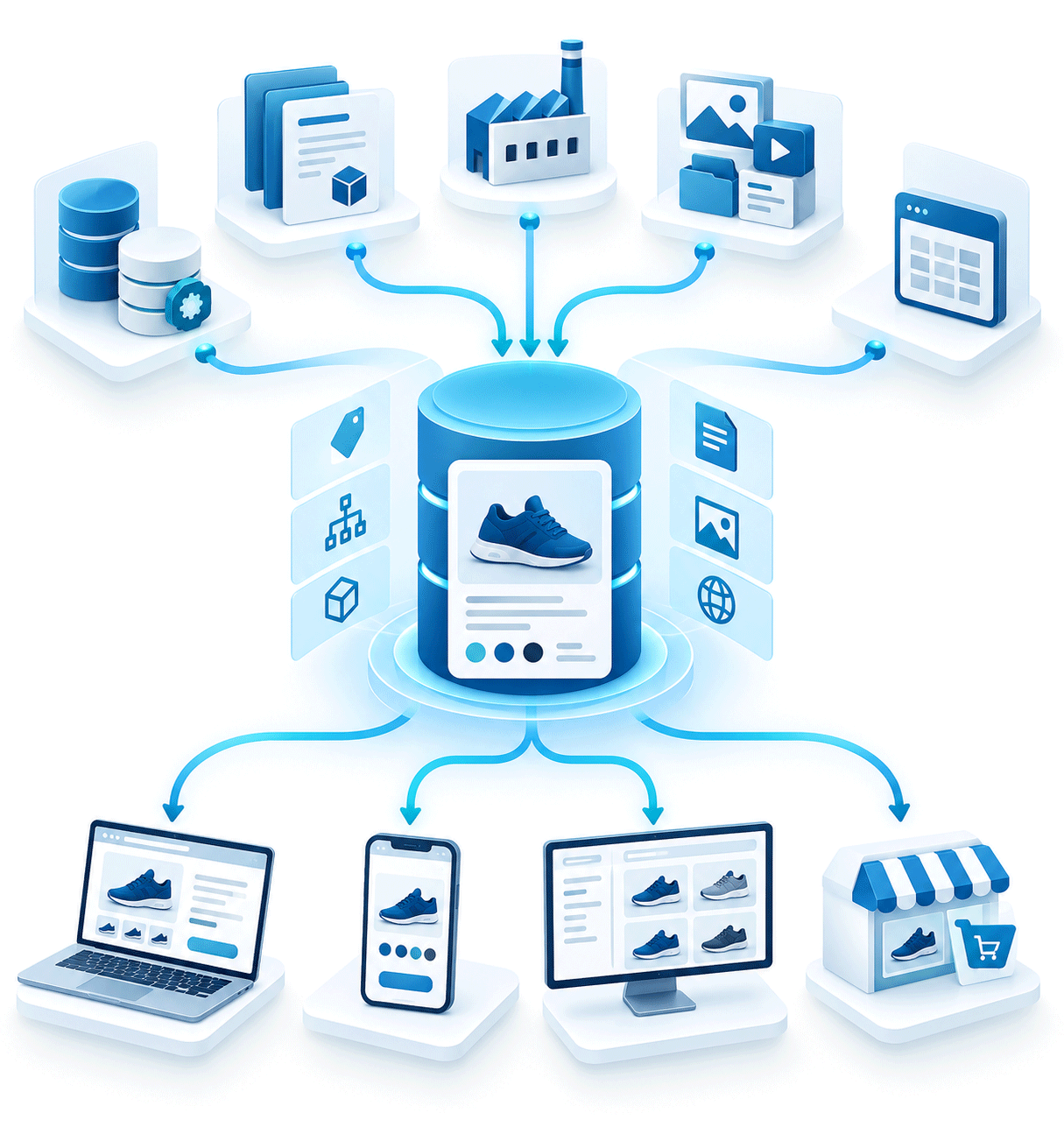
Single Source of Truth for eCommerce Product Data
Bring product information from multiple source systems into one governed product record. PIM gives eCommerce, merchandising, marketing, product, and data teams a consistent foundation for managing:
- Product identifiers and SKUs
- Technical specifications
- Product relationships
- Localized information
- Channel-ready content
With one governed product foundation, teams can reduce conflicting records and publish more consistent product experiences.
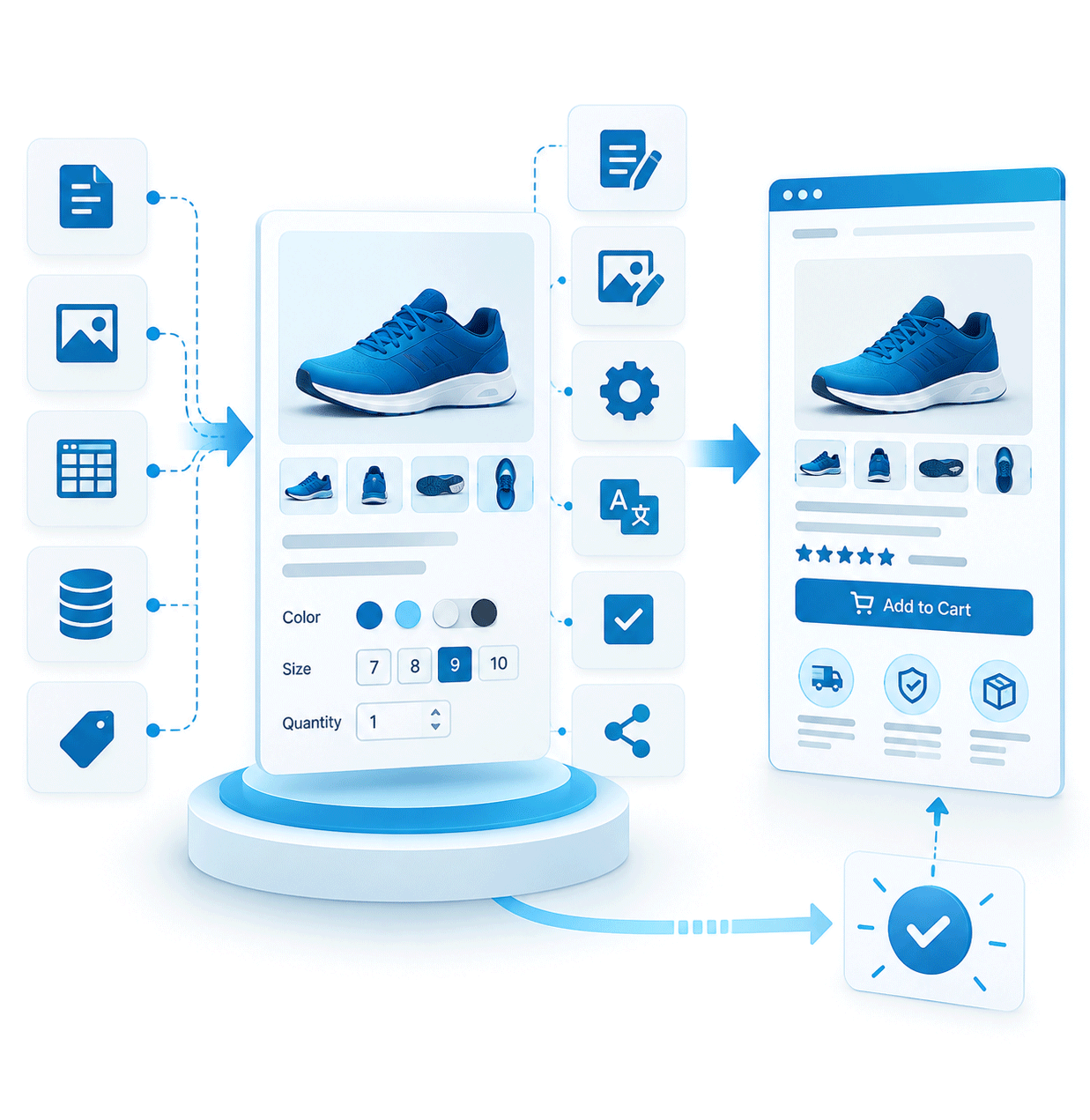
Product Enrichment and Commerce Readiness
Basic source-system data is rarely enough to create a compelling digital product experience. PIM provides structured workflows for enriching products before they reach the storefront.
Use PIM to:
- Enrich titles and product descriptions
- Connect product imagery and documents
- Define mandatory information
- Manage review and approval workflows
This helps ensure products reach eCommerce only after required information has been completed and approved.
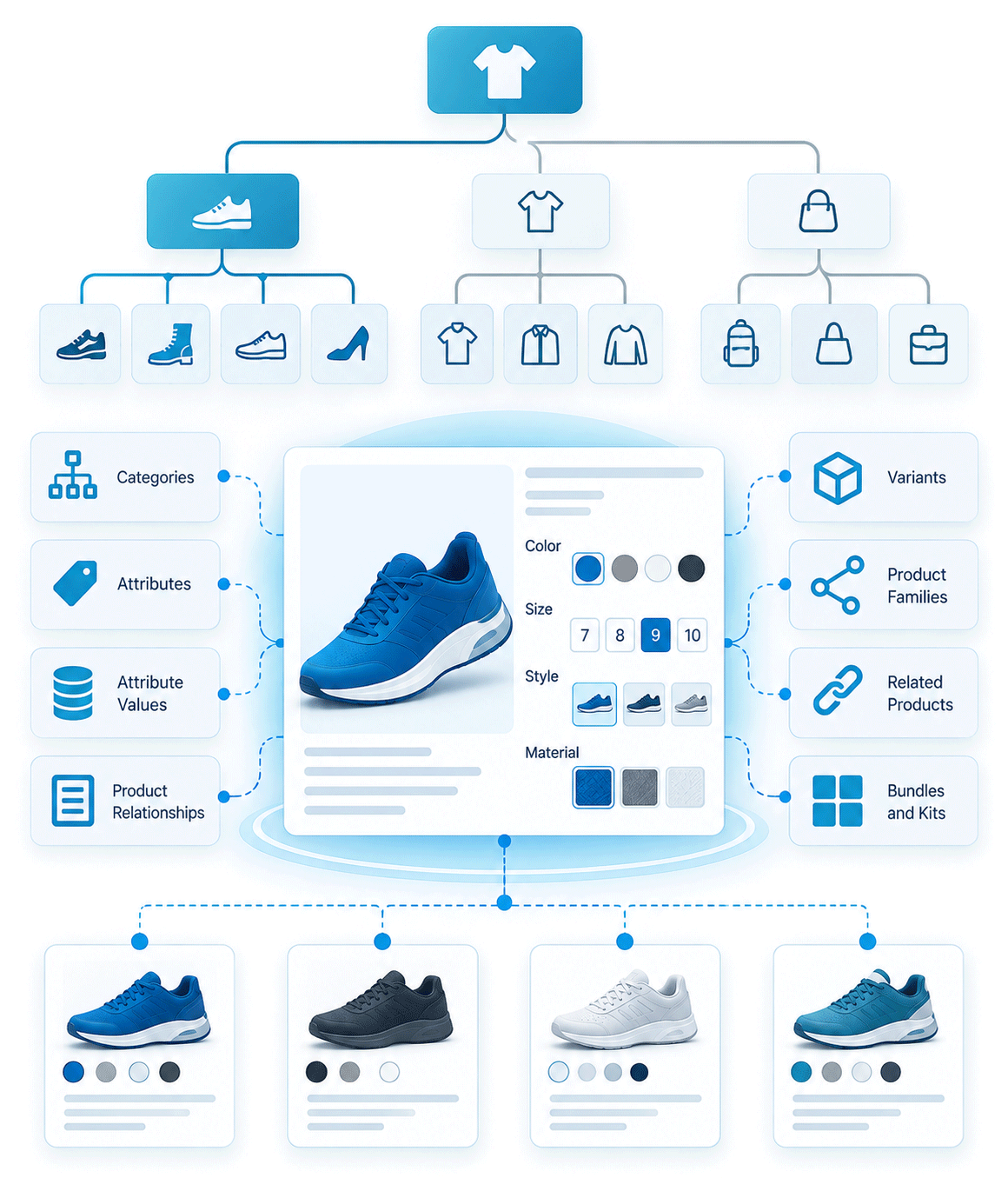
Product Taxonomy and Variant Management
A scalable eCommerce catalog depends on consistent product structure. PIM helps businesses establish governed taxonomies, attribute models, product families, and variant relationships that downstream commerce applications can use.
Manage:
- Product categories and subcategories
- Controlled values
- Size and color variants
- Bundles and kits
- Replacement products
Structured product relationships make large and complex catalogs easier to manage.
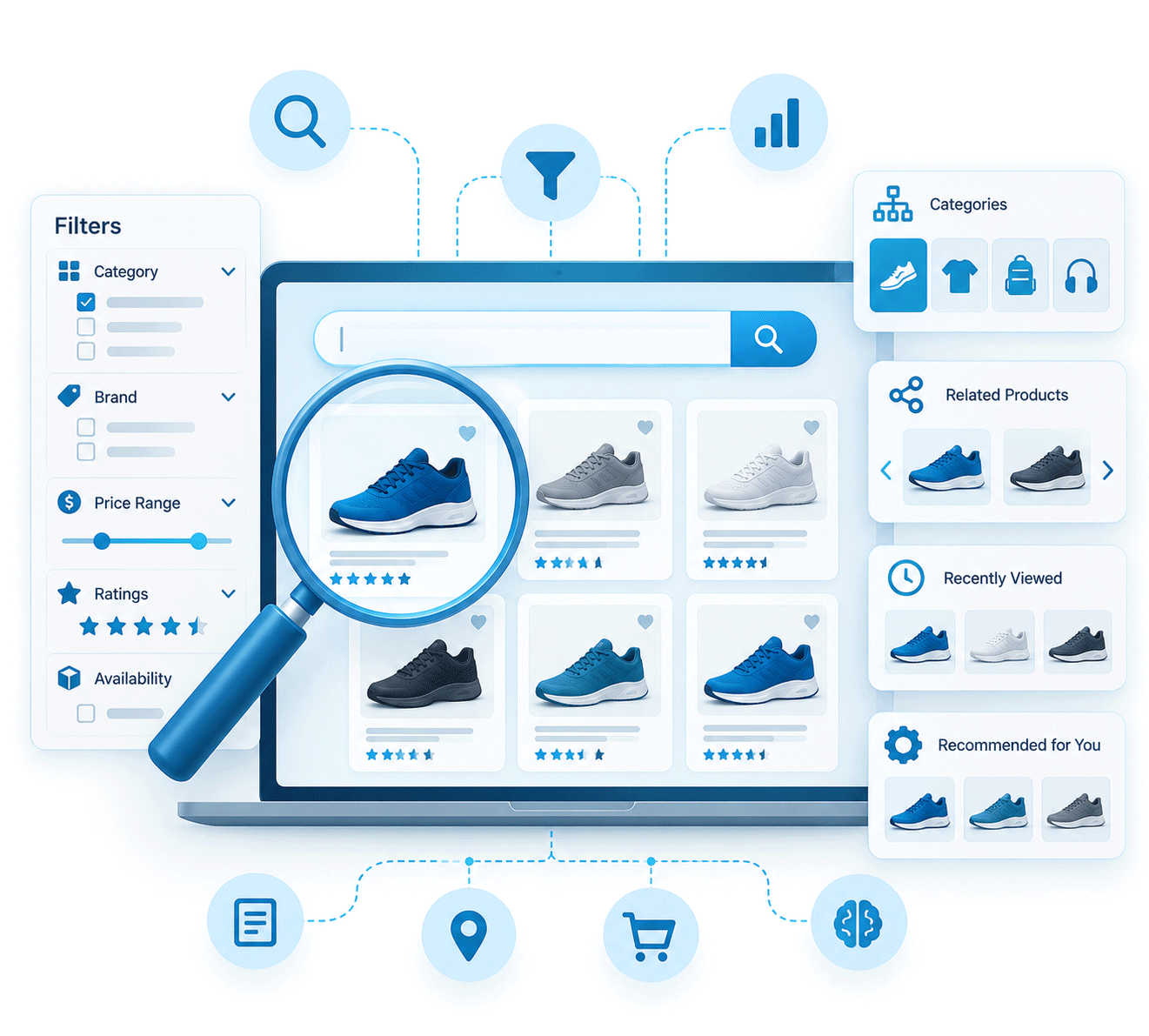
Product Search and Discovery Enablement
Search and navigation depend heavily on the quality and structure of product information. PIM provides clean, normalized product attributes that commerce search and merchandising applications can use for:
- Keyword search
- Product filters
- Related products
- Recommendation engines
Better product-data structure gives downstream systems more reliable product context.
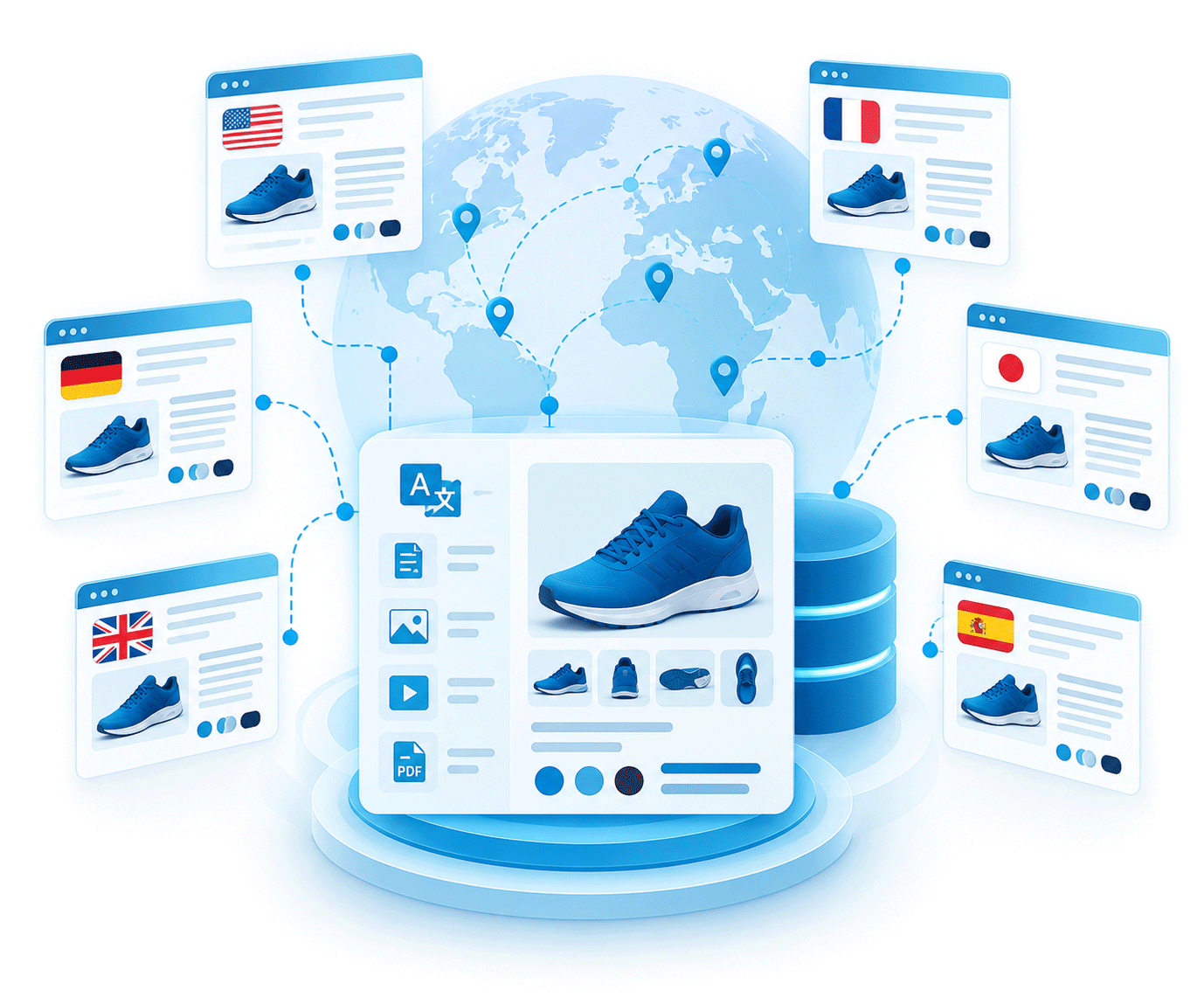
Localization and Multi-Market Product Content
PIM allows businesses to maintain global product information while managing market-specific differences. Centralize and govern:
- Product translations
- Regional attributes
- Local documentation
- Market-specific product content
Teams can reuse approved global information while maintaining controlled local variations.
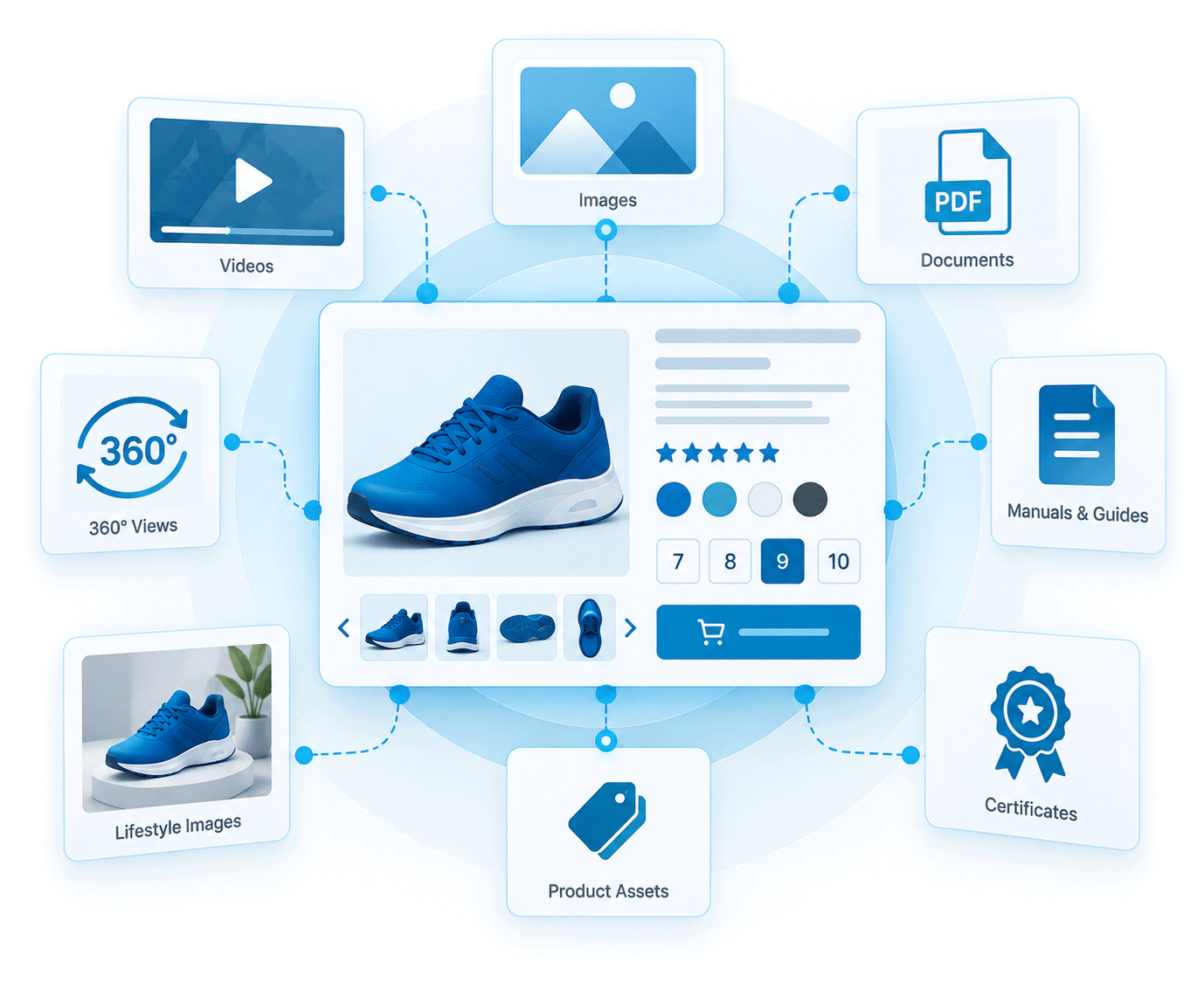
Digital Assets and Rich Product Experiences
Product information and digital assets need to work together. Integrating PIM with DAM helps teams connect structured product records with:
- Product images
- Technical documents
- Installation guides
- Marketing assets
This provides a richer and more consistent foundation for digital product experiences.
PIM eCommerce Integration: Connect Product Data with Your Digital Storefront
A successful PIM eCommerce integration creates a controlled flow of product information between enterprise systems and customer-facing storefronts. Instead of maintaining product content independently inside every commerce platform, PIM becomes the governed enrichment layer that prepares information for publication. See how a multinational retail franchise operator centralized product content for 25 Magento brand websites with Pimcore.
ERP
- Product identifiers
- SKU references
- Operational information
- Packaging information
- Pricing references
- Availability references
PLM and Supplier Systems
- Technical specifications
- Product structures
- Materials
- Engineering attributes
Supplier product information
- DAM
- Images
- Videos
- PDFs
- Manuals
- Certificates
- Marketing assets
Spreadsheets and Legacy Systems
- Existing product catalogs
- Supplier files
- Attribute data
- Historical product records
PIM becomes the central enrichment and governance layer for:
- Product taxonomy
- Attributes
- Descriptions
- Variants
- Product relationships
- Localization
- Digital content
- Completeness
- Data quality
- Approval workflows
Approved product information can then be delivered to:
- Product detail pages
- Category pages
- Site search
- Filters
- Product comparison
- Recommendations
- Localized storefronts
- Headless commerce experiences
This architecture keeps product information governed upstream while allowing the eCommerce platform to focus on the transactional customer experience.
eCommerce Platforms We Integrate with PIM
Credencys helps enterprises connect governed product information with leading eCommerce platforms and custom digital commerce environments.

eCommerce PIM Software: Which Platform Fits?
The right eCommerce PIM software depends on your catalog, channels and team. Compare 40 criteria in our free PIM platform comparison matrix, or read the best PIM for Shopify. As a Pimcore Strategic Partner and Syndigo partner, we also work independently with Akeneo, Salsify and inRiver.
Pimcore
Complex catalogs, B2B and B2C, and PIM, DAM and MDM in one open-source platform.
Akeneo
Merchandising-led brands with growing catalogs and many connectors.
Syndigo
Brands that sell through their store and many retailers and data pools.
Salsify
Consumer brands focused on retailers and the digital shelf.
inRiver
B2B manufacturers and brands with rich product stories.
Plytix
Small and mid-sized stores that want a PIM quickly.
What PIM Improves Across the eCommerce Buying Experience
Product information influences almost every stage of the online buying journey. PIM gives eCommerce teams a stronger product-data foundation for creating consistent and useful customer experiences.
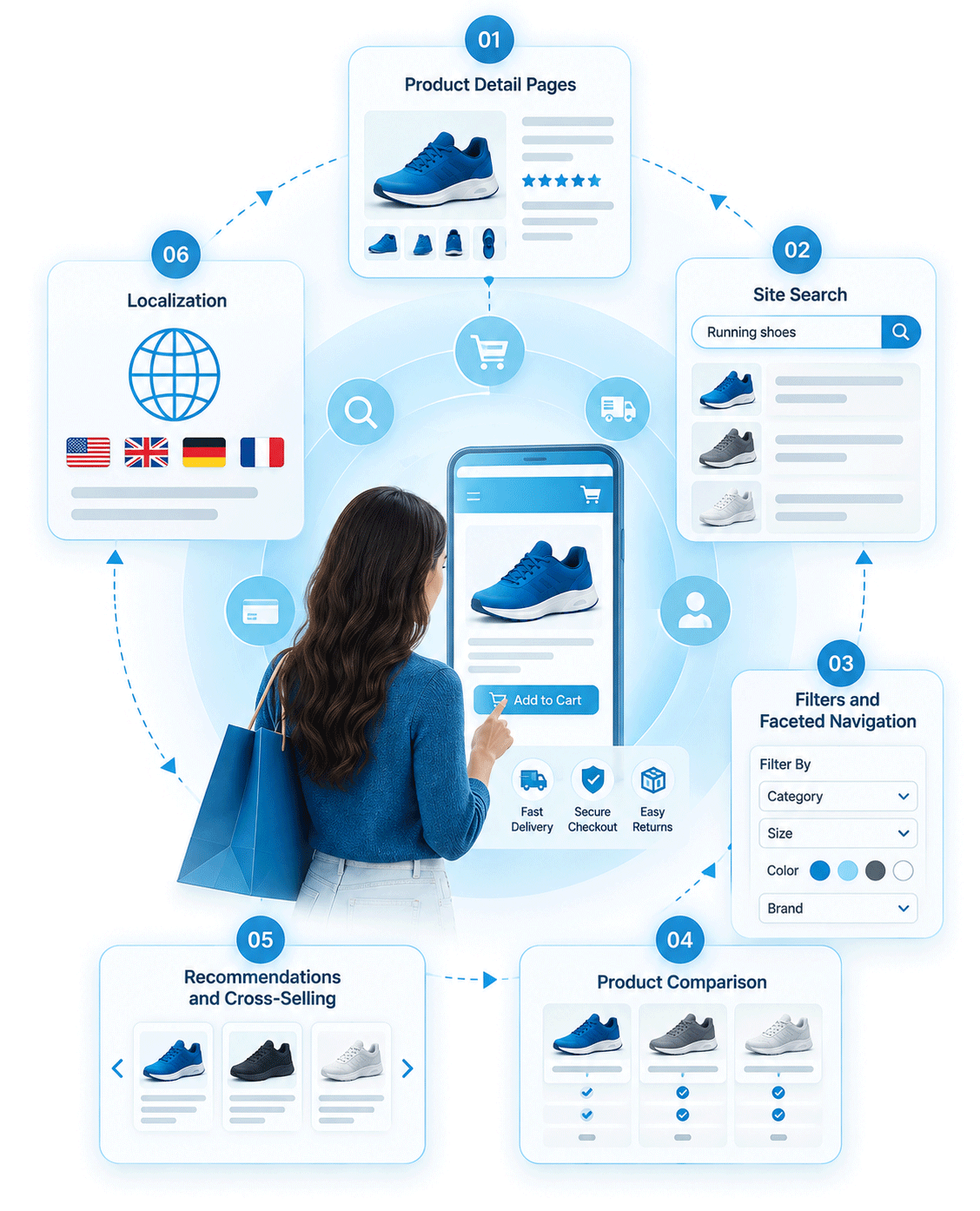
Product Detail Pages
Provide customers with complete product descriptions, specifications, imagery, documents, variants, and related-product information.
Site Search
Structured product names, attributes, categories, and relationships give search applications better information for retrieving relevant products.
Filters and Faceted Navigation
Normalized product attributes enable customers to narrow large catalogs using meaningful criteria such as size, material, capacity, compatibility, color, or technical characteristics.
Product Comparison
Consistent attribute models make it easier to present comparable specifications across related products.
Recommendations and Cross-Selling
Structured relationships between products can support accessories, alternatives, complementary products, bundles, and replacement recommendations.
Localization
Manage translated and market-specific product content from a central product model while maintaining consistency across regions.
Our Approach to PIM for eCommerce Implementation
Credencys follows a structured implementation approach designed around your product catalog, commerce platform, data sources, workflows, and digital growth objectives.
01 Assessment and Commerce Data Strategy
We analyze your existing eCommerce product-data ecosystem, including:
- Product data sources
- ERP and enterprise systems
- Product attributes
- Taxonomies
- Digital assets
- Integration requirements
Based on the assessment, we define the product-data architecture, implementation scope, governance model, and rollout priorities.
02 Product Data Modeling and Configuration
We design PIM structures around the way your products need to be managed and sold. This can include:
- Product families
- Attribute groups
- Variant models
- Validation rules
- User roles
- Localization structures
The goal is to create a scalable model that supports both current and future catalog requirements.
03 Migration, Enrichment and Integration
We consolidate product information from existing systems and prepare it for the new PIM environment. Activities may include:
- Product data migration
- Attribute mapping
- Duplicate management
- ERP integration
- Supplier-data integration
We also establish enrichment and governance workflows to keep information controlled after migration.
04 Testing, Launch and Optimization
Before deployment, we validate product information and integration behavior across the connected ecosystem. Testing can include:
- Product records
- Relationships
- Data validation
- Commerce output
- Localization
- User permissions
Following launch, we support user training, adoption, optimization, and future catalog expansion.
Real Business Impact: PIM Success Stories in eCommerce
Leading Automotive Aftermarket Retailer
50%
Improvement in Data Compliance
Credencys implemented a centralized PIM solution to unify fragmented automotive product information, standardize taxonomy, strengthen data validation, and improve product-data syndication across commerce and trading-partner environments.
Read MoreLuxury Watches & Jewelry Retailer
45%
Increase in Data Accuracy
Credencys implemented an integrated PIM, DAM, MDM, and CMS ecosystem to centralize complex product information and digital assets while improving product-data consistency across eCommerce channels. The solution streamlined enrichment, strengthened product-data governance, and enabled more efficient syndication of approved information.
Read MoreLeading U.S.-Based Retail Brand
40%
Improvement in Marketplace Control
Credencys implemented a centralized product-information solution to streamline enrichment, improve catalog completeness, simplify bulk updates, and establish better control over product content distributed across digital channels.
Read MoreWhy eCommerce Businesses Choose Credencys
Credencys combines product-data expertise, PIM implementation capabilities, and eCommerce integration experience to help enterprises build scalable digital product ecosystems.

End-to-End Product Data Expertise
From data modeling and enrichment to migration, governance, integration, and syndication, we address the complete product-information lifecycle.

PIM and eCommerce Integration Expertise
We connect governed product data with leading digital commerce platforms while maintaining clear responsibilities between PIM and transactional systems.

Enterprise Platform Experience
Our teams work across complex enterprise environments involving PIM, DAM, MDM, ERP, commerce, marketplaces, CMS, APIs, and middleware.

AI-Ready Product Data
We help businesses structure and govern product information so it can support emerging search, recommendation, conversational-commerce, and AI-driven experiences.
50+
Enterprise Clients
100%
Certified Consultants
15+
Years Experience
4.9/5
Client Satisfaction
PIM for B2C, B2B and B2B2C eCommerce
Different commerce models require different product-information structures. PIM provides a common product foundation while allowing customer-facing experiences to use the information they need.

PIM for B2C eCommerce
B2C catalogs often depend heavily on rich product presentation and product discovery. PIM can support:
- Rich descriptions
- Digital assets
- Consumer-facing attributes
- Product relationships

PIM for B2B eCommerce
B2B buyers often need deeper technical and operational product information. PIM can manage:
- Technical specifications
- Product documents
- Packaging and unit data
- Alternative and replacement products
Customer-specific pricing, ordering rules, credit terms, and transactions typically remain within ERP or B2B commerce systems.

PIM for B2B2C eCommerce
PIM allows businesses to maintain one governed product foundation while supporting different product experiences for distributors, dealers, retailers, and end customers. Shared product information can be reused while channel-specific content and requirements are maintained separately.
PIM vs eCommerce Platform: What Should Each System Manage?
PIM and eCommerce platforms work together, but they serve different purposes.
 PIM
PIM
 eCommerce Platform
Product attributes
Digital storefront
Product taxonomy
Shopping cart
Product descriptions
Checkout
Variant structures
Customer accounts
Product relationships
Promotions
Localization
Payments
Digital product content
Orders
Product completeness
Transactions
Product-data governance
Customer commerce experience
PIM enriches and governs the product record. The eCommerce platform sells the product.
PIM should not replace the systems responsible for transactional pricing, real-time inventory, orders, payments, or customer accounts. Instead, it provides those systems with complete and trusted product information.
Frequently Asked Questions
PIM for eCommerce is a centralized approach to collecting, enriching, governing, and delivering product information to an eCommerce platform. It manages product attributes, descriptions, categories, variants, relationships, localization, digital content, and other product information before that data reaches the digital storefront.
PIM becomes valuable when product information comes from multiple systems, suppliers, teams, or markets and is too complex to manage efficiently inside the eCommerce platform alone. It centralizes enrichment and governance so approved product information can be consistently delivered to the storefront.
PIM eCommerce integration connects a PIM platform with an eCommerce system so approved product information can flow from the governed product-data layer into the digital storefront. The integration may use APIs, middleware, events, connectors, or structured feeds depending on the architecture.
PIM manages and governs product information. An eCommerce platform manages the digital shopping and transactional experience.
PIM handles areas such as product attributes, descriptions, categories, variants, relationships, and localization, while the commerce platform manages storefront presentation, cart, checkout, customer accounts, promotions, and transactions.
Shopify can manage product information for relatively simple catalogs. A dedicated PIM becomes more valuable when a Shopify business manages large catalogs, complex variants, multiple suppliers, several source systems, localization, sophisticated enrichment workflows, or product information that must also be reused outside Shopify.
It depends on catalog complexity, channels and team. Pimcore suits complex B2B and B2C catalogs; Akeneo suits merchandising-led brands; Syndigo and Salsify suit brands that sell through retailers; Plytix suits smaller stores. See the PIM platform comparison matrix.
Yes. The PIM keeps one approved record and maps it to each marketplace’s requirements, so Amazon, eBay and others receive complete, correct listings.
A focused first release typically takes 3 to 6 months; larger multi-store and multi-channel programmes run in phases over 6 to 12 months or more. Discovery takes a few weeks.
Ready to Strengthen Your eCommerce Product Data?
Build a scalable eCommerce PIM foundation that supports current storefront requirements and future digital growth.
Book a Free ConsultationTrusted by Best
Choosing Credencys means partnering with a team that’s deeply committed to unlocking the true value of your data. Here’s why industry leaders trust us:
Our Valued Clientele


Send us a Message
