
The Scale and Complexity of Wine & Spirits Product Data
Wine and spirits companies manage product information across brands, vintages, varietals, appellations, bottle sizes, packaging configurations, markets, distributors, retailers, and digital channels. As portfolios expand, keeping product attributes, label information, packaging data, digital assets, and commercial content accurate and synchronized becomes increasingly difficult.
Related: PIM for food and beverage, PIM for grocery and GDSN.
Complex Product Attributes
Wine and spirits require specialized information such as vintage, varietal, appellation, origin, alcohol content, class or type, age, tasting notes, production details, and other category-specific attributes.
Fragmented Product and Label Data
Product information may be distributed across ERP, formulation systems, compliance and labeling applications, spreadsheets, DAM, distributor portals, and commerce platforms, creating multiple versions of the same product.
Multiple Bottle and Packaging Configurations
The same product may be sold across different bottle sizes, cases, gift packs, multipacks, promotional formats, and market-specific configurations, each requiring its own identifiers, dimensions, weights, and packaging information.
Complex Label and Market Requirements
Product information must support label, market, and trading-partner requirements while remaining consistent with approved product information as vintages, packaging, claims, and other details change.
Distributor and Channel-Specific Requirements
Distributors, retailers, marketplaces, control-state environments, eCommerce platforms, and international markets may require different attributes, content structures, images, classifications, and product formats.

How Much is Your Product Data Costing You?
Get Your Score + 90-day action plan in 3 minutes.
Check Your ScoreThe Strategic Role of PIM in Wine & Spirits
PIM gives wine and spirits companies a governed foundation for managing complex product information across portfolios, brands, systems, packaging levels, markets, trading partners, and customer channels. It helps standardize product data, control product changes, improve syndication, accelerate launches, and ensure teams and partners work with accurate and commercially ready information.
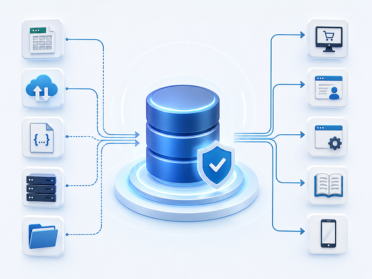
The Single Source of Truth
PIM creates one governed foundation for product names, vintages, varietals, appellations, classifications, alcohol content, tasting notes, packaging details, descriptions, digital assets, and channel content. It enables product, compliance, marketing, sales, eCommerce, and data teams to work with consistent product information.
- Consolidate product information from ERP, spreadsheets, labeling systems, DAM, and legacy applications
- Reduce duplicate and conflicting product records
- Maintain approved product information across brands, markets, and channels

Wine, Spirits, and Portfolio Data Management
Wine and spirits portfolios contain relationships that go beyond standard SKU management. A wine may change by vintage while retaining the same brand and product family.
A spirits portfolio may include different ages, expressions, proofs, finishes, bottle sizes, limited releases, and related products.
- Manage brands, product families, expressions, vintages, and variants
- Structure varietal, appellation, origin, class/type, age, ABV, and category information
- Connect related products, previous vintages, sizes, gift packs, and special editions

Standardized Product and Packaging Information
Distributors and retailers need reliable product and trade-item information before a product can move efficiently across downstream systems and channels. PIM standardizes product attributes and packaging structures while maintaining relationships between consumer units and higher-level configurations.
- Manage GTINs, bottle sizes, cases, multipacks, and packaging relationships
- Standardize dimensions, weights, units, and pack quantities
- Apply category-specific validation and completeness rules

Label Data Governance and Market Readiness
Wine and spirits labels contain regulated product information that must remain aligned with approved product records. PIM helps govern and distribute the underlying product attributes used by labeling and compliance workflows without replacing regulatory review or label-approval systems.
- Maintain approved product and label-related attributes centrally
- Control changes to vintage, appellation, ABV, age, class/type, and other information
- Associate approved label artwork, certificates, documents, and related assets
- Route product changes through structured review and approval workflows

Omnichannel Commerce and AI Readiness
Consumers and trade buyers increasingly discover wine and spirits through retailer websites, marketplaces, digital catalogs, brand websites, distributor platforms, and search experiences. Structured PIM data provides the foundation for richer discovery and more consistent product storytelling.
- Improve product search, filters, comparison, and recommendations
- Support discovery by varietal, region, appellation, vintage, spirit type, age, flavor profile, and other attributes
- Deliver enriched product content across digital channels
Our Approach to PIM Implementation Services
Our PIM implementation services help wine and spirits businesses structure product, vintage, packaging, label-related, distributor, and digital-channel information within a governed PIM environment.
01
Assessment and Planning
Analyze your product portfolio, brands, vintages, product-data sources, labeling processes, packaging structures, systems, trading partners, markets, channels, and business priorities to define a clear PIM implementation roadmap.
02
Customization and Configuration
Design wine- and spirits-specific product models, categories, attributes, packaging hierarchies, product relationships, validation rules, workflows, user roles, and integrations.
03
Enrichment and Governance
Cleanse and migrate existing product information, standardize attributes and values, establish data ownership, associate approved digital assets, and configure enrichment, validation, review, and approval workflows.
04
Deployment and Training
Launch PIM across priority brands, categories, markets, distributors, and digital channels, train internal teams, monitor adoption, and provide ongoing post-deployment support.
Business Impact of PIM for Wine & Spirits
PIM transforms fragmented wine and spirits information into a governed business asset. It reduces manual data work, improves product accuracy, accelerates product and vintage launches, strengthens distributor readiness, and enables richer digital product experiences across every channel.



Ready to Modernize Your Wine & Spirits Product Data?
Build a trusted product-data foundation that improves product accuracy, strengthens label-data governance, accelerates distributor and retailer syndication, and delivers richer wine and spirits experiences across every channel.
Book a Free ConsultationWhy Leading Enterprises Choose Credencys?
Credencys helps enterprises turn complex data into trusted insights, intelligent operations, and measurable business growth. Here’s what makes us a preferred data and AI partner:

End-to-End Data Expertise
From data strategy to AI deployment, we cover the entire spectrum—Data Management, Engineering, Insights, and Intelligence—to ensure your data drives measurable business outcomes.

Domain-Focused Solutions
Whether you're in retail, automotive, or manufacturing, our purpose-built platforms solve industry-specific challenges with precision and speed.

Enterprise-Grade Partnerships
We collaborate with the best in the business to deliver future-ready, scalable, and secure solutions.

AI-First
We help you move beyond dashboards—accelerating AI readiness, deploying GenAI and enterprise AI agents, and enabling intelligent automation across your data ecosystem.
50+
Enterprise Clients
100%
Certified Consultants
15+
Years Experience
4.9/5
Client Satisfaction
We Build PIM Solutions for


Frequently Asked Questions
PIM for Wine & Spirits is a centralized approach to collecting, structuring, enriching, governing, and distributing product information for wine, spirits, and related beverage products. It helps companies manage information such as brand, product type, vintage, varietal, appellation, origin, ABV, age, tasting information, bottle size, packaging, images, documents, product relationships, and channel-specific content.
Wine and spirits companies manage specialized product information across ERP, labeling applications, spreadsheets, DAM, distributor systems, retailer portals, eCommerce platforms, and other applications. Product portfolios also change through new vintages, expressions, packaging formats, markets, limited editions, and product updates.
PIM creates one governed product-information layer that connects these sources and makes approved information reusable across teams, partners, and customer channels.
PIM can maintain relationships between a wine brand or product family and its individual vintages. Each vintage can retain attributes such as year, varietal composition, appellation, tasting information, product descriptions, bottle images, documents, identifiers, and channel-specific content while inheriting common information from the parent product where appropriate.
Yes. PIM can create structured fields and controlled values for varietals, appellations, AVAs, regions, countries of origin, and related wine attributes. These attributes can then be validated, governed, searched, filtered, and distributed consistently.
Yes. PIM can structure attributes including class/type, alcohol percentage, age information, origin, bottle size, product description, and other spirits-specific data. TTB requires information such as brand name, class/type and alcohol content on distilled spirits labels, along with other mandatory information depending on the product.
Yes. A PIM workflow can route label text and artwork through review and approval steps, and only approved versions are published to channels.
A PIM can flag alcohol products and control which data goes to which channel, so retailers and marketplaces with age-verification rules receive the attributes they require.
Trusted by Best
Choosing Credencys means partnering with a team that’s deeply committed to unlocking the true value of your data. Here’s why industry leaders trust us:
Our Valued Clientele


Send us a Message
