
The Complexity of Product Data Syndication
Every retailer, marketplace, distributor, and commerce destination expects product data in its own structure. As product catalogs and channel ecosystems grow, businesses spend increasing amounts of time mapping attributes, correcting incomplete records, transforming files, resolving rejected products, and maintaining channel-specific requirements.
Different Channel Data Requirements
Every destination may require different categories, attributes, identifiers, formats, mandatory fields, value structures, and validation rules.
Fragmented Product Data Sources
Product information often comes from ERP, PIM, PLM, supplier feeds, spreadsheets, DAM, databases, and legacy systems, creating multiple versions of the same product record.
Inconsistent Attributes and Taxonomies
Different terminology, classifications, units, attribute structures, and supplier values make downstream mapping and standardization difficult.
Incomplete and Rejected Product Data
Missing identifiers, required attributes, classifications, dimensions, or incorrect values can delay listings and increase manual corrections.
Continuous Product and Channel Changes
New SKUs, product updates, assortment changes, retailer requirements, category changes, and new destinations create constant syndication work.

How Much is Your Product Data Costing You?
Get Your Score + 90-day action plan in 3 minutes.
Check Your ScoreHow Product Data Syndication Works
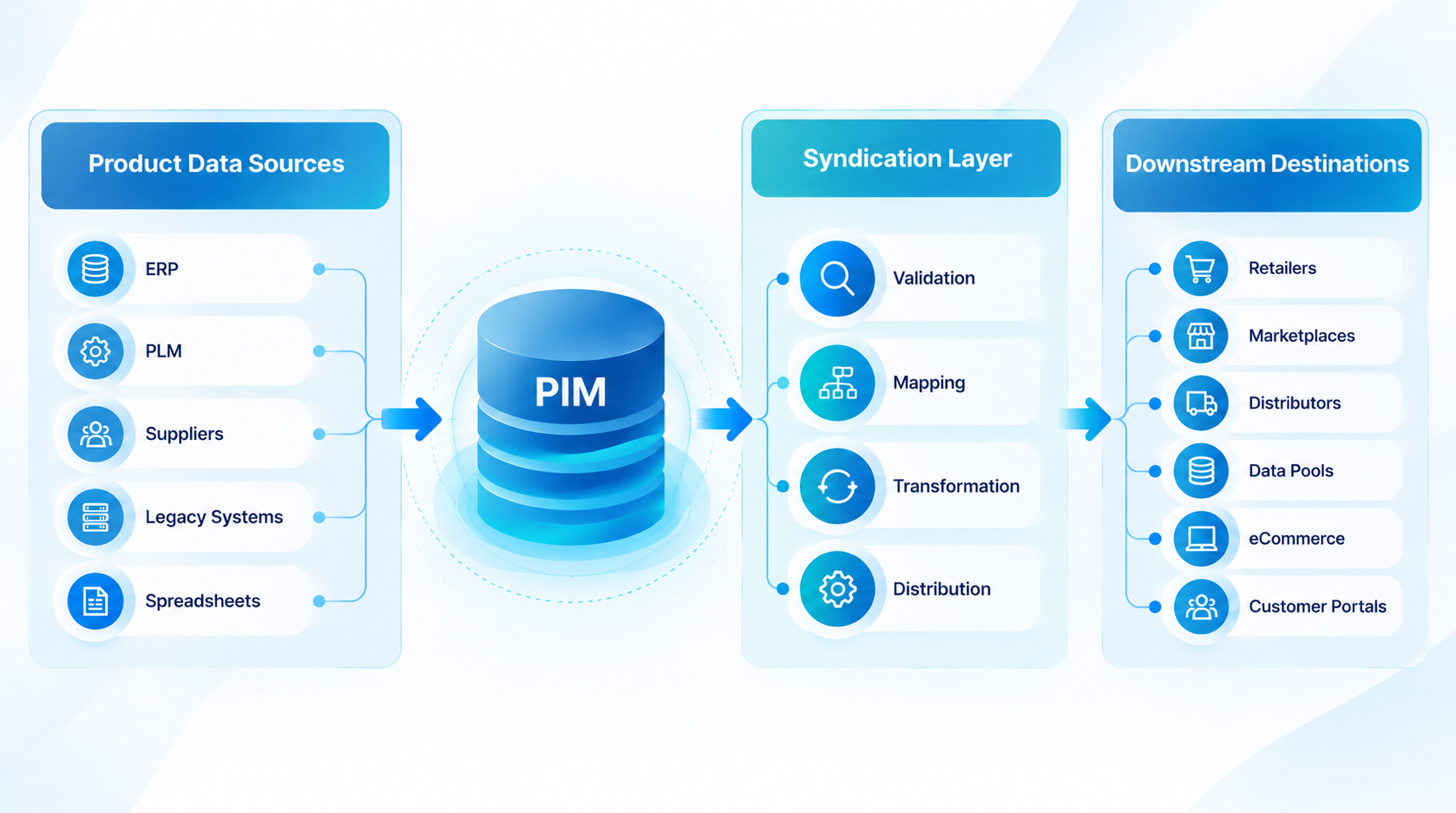
Product data syndication connects your governed product-information foundation with the retailers, marketplaces, distributors, and digital systems that consume it.
Product Data vs Product Content Syndication
Product data syndication sends structured facts (identifiers, attributes, specifications, classifications) in the format each destination needs. Product content syndication adds the customer-facing layer: descriptions, feature bullets, images, videos, documents and rich media, adapted to each retailer’s rules.
Most retailers require both, so we design them as one flow from your PIM: validate, map, transform, publish, and check what each channel accepted or rejected. See our product data syndication guide.
What Every Syndication Flow Needs
Whatever the channel, four things decide whether your products go live correctly.
Channel-Specific Transformation
Titles, units, category codes and values rewritten for each channel.
Rich Media
Images, videos and documents in the sizes and formats each channel accepts.
Validation Before Sending
Completeness and rule checks catch rejections before the retailer does.
Feedback Loop
Errors and rejections from channels come back to the right person in the PIM.
Product Data Syndication Across Your Channel Ecosystem
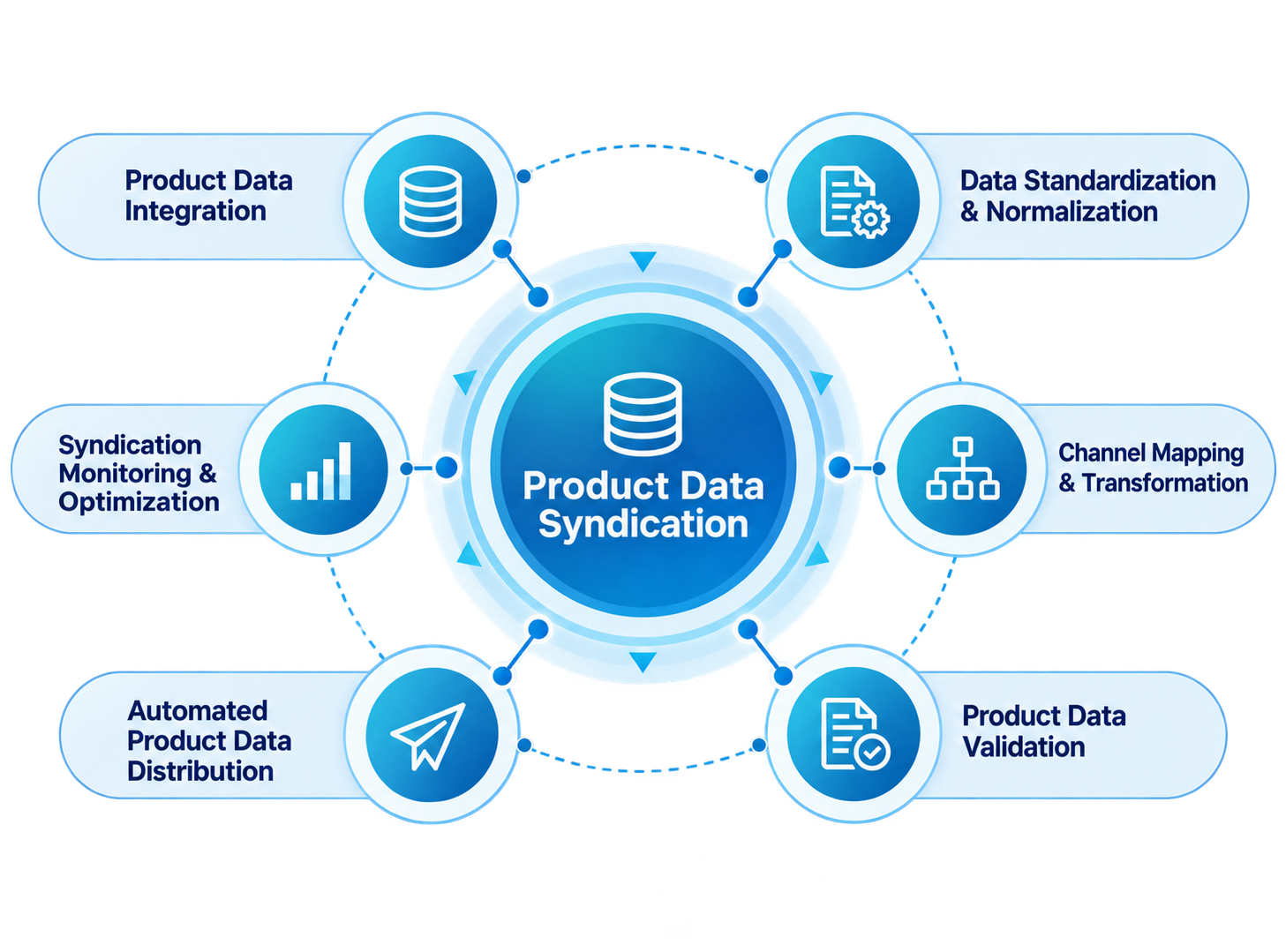
Build one governed product-data foundation and distribute it across the destinations that drive your business.
Retailers
Prepare and distribute accurate product information according to retailer-specific categories, attributes, identifiers, and listing requirements.
Marketplaces
Transform governed product records into marketplace-ready structures while reducing repeated manual feed preparation.
Distributors
Deliver standardized product information to distribution partners, dealer networks, and B2B customers.
Data Pools & Industry Networks
Support structured product-data exchange and industry-specific syndication requirements where applicable.
eCommerce Platforms
Provide digital storefronts with consistent product categories, attributes, relationships, and enriched product information.
Customer & Partner Portals
Distribute governed information to sales portals, B2B platforms, dealer systems, customer applications, and custom digital experiences.

Business Impact of Product Data Syndication
Product data syndication reduces the operational friction between your governed product-data foundation and the channels that consume it.

Faster Channel Onboarding
Reduce manual mapping and preparation when adding new retailers, marketplaces, distributors, and commerce destinations.
Fewer Product Data Errors
Validate product information before distribution to reduce incomplete, inconsistent, and rejected records.
Faster Product Launches
Automate channel preparation and syndication so new and updated products reach downstream destinations sooner.
Lower Manual Data Effort
Reduce spreadsheet processing, repetitive transformations, feed maintenance, and manual corrections.
Consistent Product Information
Maintain one governed product-data foundation while adapting information to the requirements of individual destinations.
Improved Catalog Completeness
Identify missing mandatory attributes and resolve product-data gaps before publication.
Scalable Channel Expansion
Add new channels without recreating the complete product-data process for every destination.
Stronger Data Governance
Maintain traceable mappings, validation rules, exception processes, and downstream distribution workflows.
Real Business Impact: Product Data Success Stories
Leading Automotive Aftermarket Retailer
50%
Improvement in Data Compliance
Credencys implemented a centralized PIM solution to standardize automotive product information, strengthen ACES and PIES compliance, and improve the accuracy of product data shared across trading partners and digital channels. The solution reduced data inconsistencies and accelerated catalog updates across the client's downstream ecosystem.
Read MoreFull-Line Electrical Distributor
58%
Faster Manufacturer Onboarding
Credencys implemented a governed PIM foundation for an electrical distributor managing a large multi-manufacturer catalog. Automated ingestion, mapping, validation, approval workflows, and standardized product structures helped the organization onboard manufacturer data faster and improve downstream catalog readiness.
Read MoreGlobal B2B2B Sourcing & Supply Chain Company
200+
Factory Partners Connected
Credencys implemented a centralized PIM and DAM platform to consolidate product information and media assets received from more than 200 factory partners. The solution replaced spreadsheet, presentation, and email-driven product-data processes with standardized onboarding, catalog management, product discovery, and automated workflows.
Read MoreOur Approach to Product Data Syndication
We follow a structured implementation approach to move product information from fragmented source systems to governed, channel-ready distribution, without disrupting existing enterprise operations.
Key activities:
- Audit source systems and product-data quality
- Review retailer, marketplace, and distributor requirements
- Identify mapping and completeness gaps
- Prioritize channels and product categories
- Define rollout scope and success metrics
Key activities:
- Define attribute and taxonomy standards
- Normalize values and units
- Establish product-data ownership
- Design source-to-target mappings
- Define validation and exception rules
Key activities:
- Configure mappings and transformations
- Integrate PIM, ERP, DAM, PLM, and other systems
- Set up feeds, APIs, files, or connectors
- Automate validation and approval workflows
- Configure exception handling and monitoring
Key activities:
- Launch priority destinations
- Validate syndicated data
- Resolve rejected or incomplete records
- Monitor mapping and delivery issues
- Onboard additional channels
- Optimize data quality and operational efficiency
PIM + Product Data Syndication
A scalable syndication strategy starts with governed product information. PIM creates the trusted product-data foundation.
Product Data Syndication converts that governed information into the structures required by downstream systems and delivers it at scale.
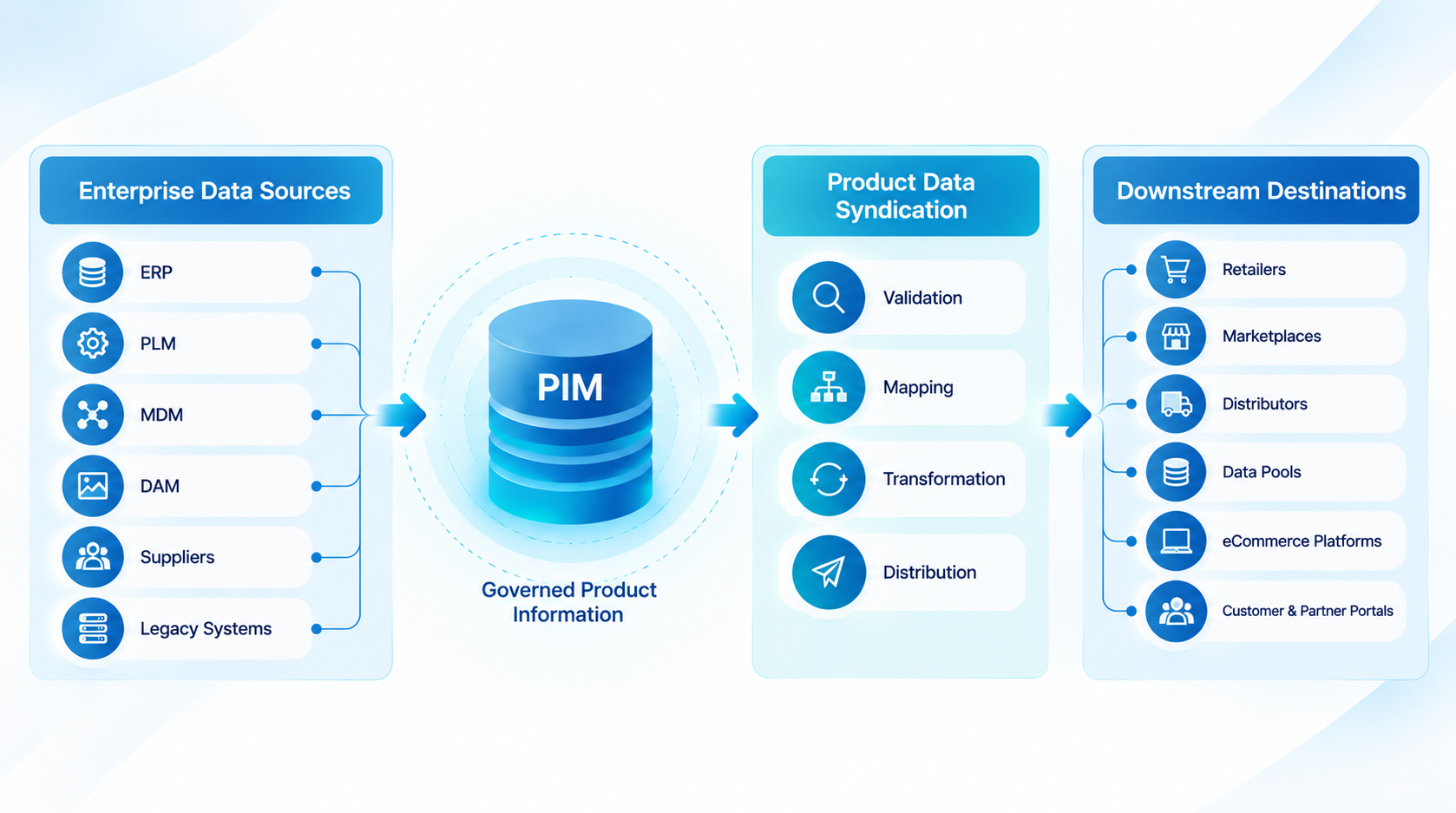
Why Leading Enterprises Choose Credencys?

End-to-End Data Expertise
From data modeling and governance to PIM, integration, and syndication, we address the complete product-data lifecycle rather than solving individual channel problems in isolation.

Domain-Focused Solutions
We design product-data models, workflows, and syndication processes around the requirements of your industry, catalog, channels, and customers.

Enterprise-Grade Partnerships
Our product-data expertise is supported by experience with enterprise PIM, MDM, integration, commerce, and syndication platforms.

AI-First
We help enterprises build structured, governed product-data foundations that can support intelligent automation, data-quality workflows, and future AI use cases.
50+
Enterprise Clients
100%
Certified Consultants
15+
Years Experience
4.9/5
Client Satisfaction
Ready to Simplify Product Data Syndication?
Standardize product information, automate channel mapping, reduce syndication errors, and deliver trusted product data to every downstream destination.
Book a Free ConsultationFrequently Asked Questions
Product data syndication is the process of transforming and distributing product information from a governed source to external destinations such as retailers, marketplaces, distributors, data pools, commerce platforms, and customer portals. It helps ensure each destination receives accurate product information in the structure and format it requires.
Product information is first collected and governed in systems such as PIM. A syndication process then validates the data, maps attributes and categories to destination-specific requirements, transforms values or formats where necessary, and distributes the information through APIs, feeds, files, connectors, or other integrations.
PIM manages and governs product information centrally. Product data syndication takes that governed information and prepares it for individual downstream destinations.
PIM answers: What is the trusted product record?
Product data syndication answers: How does that record need to be structured and delivered for this destination?
Product data syndication focuses primarily on structured product information such as attributes, identifiers, categories, specifications, units, classifications, mappings, and destination schemas. Product content syndication focuses more heavily on customer-facing content such as descriptions, images, videos, rich content, marketing copy, and localization.
The two capabilities often work together but serve different purposes.
Enterprises often sell through many retailers, distributors, marketplaces, and digital platforms. Each destination can have different product-data requirements.
Without syndication, teams repeatedly transform and maintain the same information manually for every destination. Product data syndication creates a scalable process for validating, transforming, and distributing governed information.
Any destination that accepts feeds, files or APIs, including marketplaces such as Amazon and Walmart, retailer portals, GDSN data pools and distributor portals. With Syndigo, you also reach its network of retailers and recipients. See Syndigo and product data quality.
Trusted by Best
Choosing Credencys means partnering with a team that’s deeply committed to unlocking the true value of your data. Here’s why industry leaders trust us:
Our Valued Clientele


Send us a Message
